


Christopher Hensley runs Houston First Financial Group in Houston, serving state higher education employees age 55 and older, preparing for retirement. He operates the firm on his own.
For years, intake and follow-up were handled with administrative support. When his assistant moved on, that work shifted back to him. The advisory work did not change, and clients were still onboarded as they always had been, but the operational effort required to move each household through the process became more visible once he was managing every step directly.
The process itself wasn’t broken. It just required more manual coordination than he wanted to carry long-term.
What Onboarding Looked Like Before
Onboarding involved a mix of paper packets, PDFs and digital forms. Clients completed documents and returned them. The information was reviewed and then entered into Wealthbox and planning software. Some fields were typed in manually, others copied from attachments, and tax returns were requested through separate email threads running alongside everything else.
If something was missing, a reminder went out. If it was still missing, another followed.
To see where a client stood, he moved between his inbox, task list and sometimes his calendar because there was no single intake view that showed status from start to finish. Data moved between systems only when someone moved it, which meant the process depended on active oversight at each stage.
That structure worked, but it required someone constantly stitching the pieces together.
Where the Friction Lived
Once support was gone, those handoffs were no longer background work.
A client would send back a PDF, and that same retirement account number would end up typed into two different systems before the first meeting even happened. To confirm intake was complete, he would open his inbox, then Wealthbox, then the planning software, checking each one to make sure nothing had been missed. Reminder emails followed a familiar pattern, but they still required time to draft and send.
None of the steps were difficult. They were repetitive, and most of the drag came from moving the same information through the firm more than once. In a solo practice, repetition compounds quickly because there is no one else absorbing it.
The advisory work was where his attention needed to be. The transfer of data between tools was what kept pulling it away.
At that point, the goal wasn’t to modernize the firm. It was to reduce the number of times the same information had to be handled manually.
Moving Intake to the Front of the Workflow
He started by looking for a better way to handle forms. Paper packets and PDFs were the most visible friction, so replacing them was the first step. But once intake was rebuilt digitally, it became clear that it made sense to treat it as the starting point of the workflow rather than just a document step.
PreciseFP was introduced to replace paper and PDF intake, and over time, it became the system where client information originates. When a prospect schedules a meeting through Calendly, a record is created inside PreciseFP. Engagements build on previously captured information, so clients are not re-entering core data with every new request.
Instead of collecting documents and later translating them into systems, intake now begins in a structured format. Account balances and beneficiary details no longer need to be typed separately into Wealthbox and planning software because the data flows forward from the original intake. Tax documents requested through engagements are routed for processing, and status can be reviewed from one place rather than reconstructed across inbox threads.
The result was fewer manual transfers between systems and less “need to double-check that information landed in the right place”.
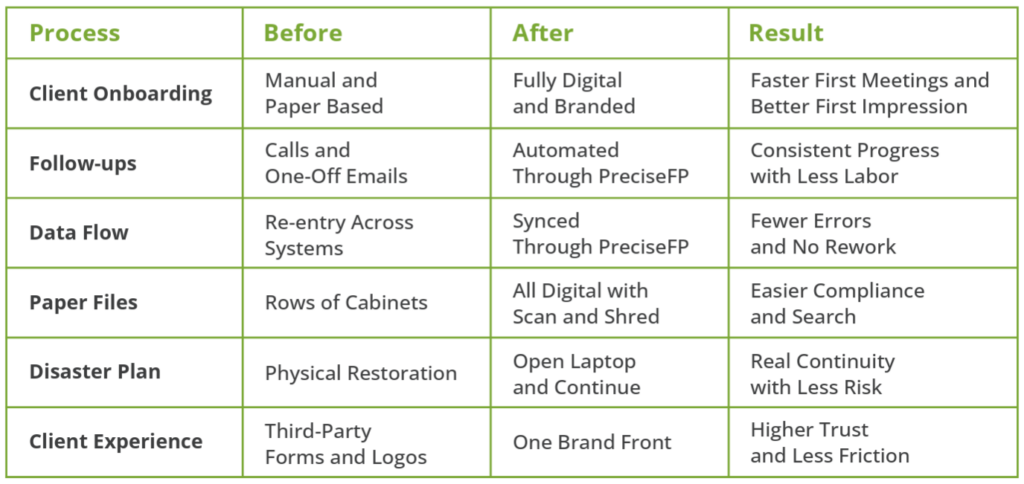
What Changed in the Client Onboarding Workflow
As intake moved forward in the process, several manual steps dropped away. Fewer reminder emails had to be written. Duplicate entry declined because information was moved forward instead of being copied across systems. Paper shifted to scan-and-shred rather than temporary stacks waiting to be processed.
Clients did not need to understand the tools behind the scenes. What they experienced was fewer repeated questions, clearer progress and consistent branding across forms and requests. The advisory conversations remained the same, but the administrative effort surrounding them decreased.
What Comes Next
The firm did not expand its staff or change its niche. Instead, it tightened the front end of the onboarding process so fewer small tasks required direct supervision. In a solo practice, that kind of structural stability matters more than scale.
Chris reviews his technology stack quarterly and tracks cost and overlap in Notion. Tools remain only if they reduce effort or clarify the workflow. PreciseFP continues to anchor intake because it supports structured data capture across the rest of the stack, and refinements happen incrementally as the practice evolves.
For a deeper look at the workflow and integration details, download the full case study here.
Christopher Hensley shares more of his thinking on firm operations and technology on the Money Matters podcast at moneymatterspodcast.com. He is also the author of Digital Kaizen, with Digital Kaizen for Financial Advisors in progress.
If you are reviewing how intake, follow-ups and data collection are handled inside your own firm, you can explore the same system Christopher uses by starting a 14-day free trial now.